Background
Shumate Mechanical sells, designs, and installs heating and air conditioning systems for commercial applications such as office buildings, schools, and retail stores. The projects we work on are classified under two categories. One is called tenant finish, which are jobs that we design ourselves. The other category is called plan and specification, which is designed by outside engineering groups. Projects in this category have to be installed exactly the way the other engineering groups specify. In both cases, the sales person has to estimate the price of the project up front and give a proposal to the customer.
Purpose
The purpose of this report is to document how close the sales team’s estimates are in relation to the actual costs of the projects. In knowing this, we will be able to determine if we are really making the profit margins we are aiming for on the projects. I have also broken the total estimated and actual costs into four categories: labor, materials, equipment, and subcontractors. These sub-categories will enable us to narrow down which areas of the estimate are accurately priced and which ones need to be modified to properly reflect the actual costs. The labor category includes piping, sheet metal, controls, and prep & startup labor. The subcontractor category contains all rentals, subcontractors, permits, and warranty.
Tenant Finish Projects
Actual cost and estimate data was gathered on all tenant finish projects that were completed in the year 2001. The estimated and actual costs for 465 projects were recorded and put in a useable form in Microsoft Excel. A histogram with a frequency chart was used to show the price ranges of the jobs Shumate Mechanical completed during last year.
|
Frequency
table for Sales Price |
||
|
|
|
|
|
Upper limit |
Category |
Frequency |
|
5000 |
<=5000 |
199 |
|
15000 |
5000- 15000 |
129 |
|
25000 |
15000- 25000 |
52 |
|
35000 |
25000- 35000 |
31 |
|
45000 |
35000- 45000 |
9 |
|
55000 |
45000- 55000 |
14 |
|
65000 |
55000- 65000 |
6 |
|
75000 |
65000- 75000 |
6 |
|
85000 |
75000- 85000 |
3 |
|
|
>85000 |
16 |
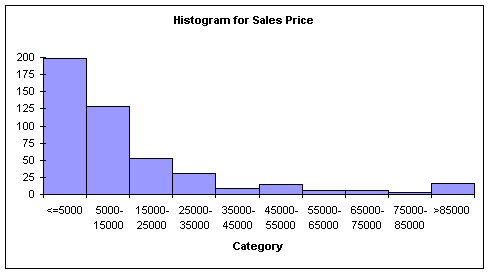
This histogram graphically shows the frequency of project prices in each category. The graph shows that 70% of our tenant finish jobs are below $15,000. Only sixteen projects were above $85,000 with the largest project being $755,786. Using descriptive statistics I was able to find some useful facts about the project completed last year, which are shown in the table below.
|
Sales Price |
|
|
|
|
|
Mean |
$19,000 |
|
Standard
Error |
$2,230 |
|
Median |
$6,525 |
|
Standard
Deviation |
$48,090 |
|
Range |
$755,786 |
|
Minimum |
$130 |
|
Maximum |
$755,916 |
|
Total
Sales |
$8,835,427 |
|
Number of
Projects |
465 |
|
Confidence
Level (95.0%) |
$4,382 |
When comparing the variance of the total estimated cost with the total actual cost I assumed the cost of warranty for tenant finish projects to be 2% of the total sales price, which is historically what it has been. Also, only original contract amounts were used to determine the variances. The data collected did not breakdown change order prices into the proper categories. The estimated data used is based on the breakdown costs that the sales team put into the work orders. The results are directly affected by how accurate the sales team split up the pricing data within the categories of the work orders. This does not account for higher markups used to compensate for the estimated pricing.
The variances for the total price as well as the difference in estimated and actual cost are shown in the table below.
Variance of Estimated vs. Actual Costs
|
Total |
-3.2% |
-$203,350 |
|
Labor |
-8.9% |
-$131,426 |
|
Material |
-11.3% |
-$171,826 |
|
Equipment |
2.5% |
$60,486 |
|
Subcontractors |
4.8% |
$39,416 |
The total price variance for tenant finish pricing was at –3.2%. This shows that the sales team was under-estimating last year’s total actual costs by $203,350. The total price was split up into four categories to help determine which areas the sales team was under-estimating. The two categories that were severely under-estimated were labor by 8.9% or $131,426 and material costs by 11.3% or $171,826. The other two categories, equipment and subcontractors were slightly on the positive side by 3% or $60,486 and 5% or $39,416, respectively. The results show we need to concentrate on the labor and material costs to determine why they have such large variances. There is probably a combination of the sales team under-estimating the categories and production using more labor and materials than is needed to complete the projects.
The average percentages of the actual costs of the projects for the four categories are shown in the pie chart below. The percentages can be used as a guideline when estimating future projects.
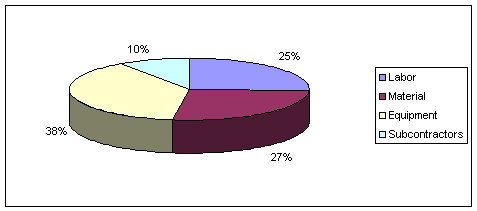
The actual labor costs for the projects are on average 25% of the total actual costs. This percentage can be used after the estimate is done to quickly double check the numbers to make sure everything seems normal. If an estimate winds up with labor costs that are 15% of the total job, there are good grounds to double check the estimate and make sure the estimated labor is justified. The same principle can be applied for the other three categories as well.
Plan and Specification Projects
Actual cost and estimate data was also gathered on all plan and specification projects that were completed in the year 2001. A total of 105 projects completed last year were recorded and put in a useable form in Microsoft Excel. A histogram with a frequency chart was used to show the price ranges of the jobs Shumate Mechanical completed in this category of projects.
|
Frequency
table for Sales Price |
||
|
|
|
|
|
Upper limit |
Category |
Frequency |
|
20000 |
<=20000 |
48 |
|
40000 |
20000- 40000 |
20 |
|
60000 |
40000- 60000 |
10 |
|
80000 |
60000- 80000 |
6 |
|
100000 |
80000- 100000 |
3 |
|
120000 |
100000- 120000 |
4 |
|
140000 |
120000- 140000 |
3 |
|
|
>140000 |
12 |
|
|
TOTAL |
106 |
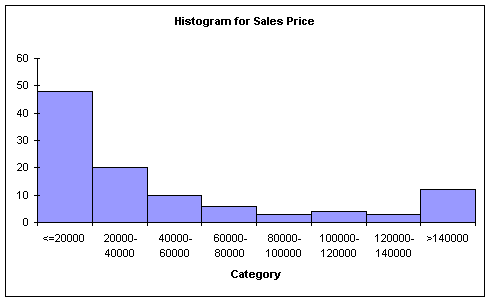
This histogram graphically shows that 45% of our plan and specification projects were below $20,000. Twelve projects were above $140,000 with the largest project being $485,716. Using descriptive statistics I was able to compare how the data in this category compares with that of tenant finish. The information is shown in the table below.
Sales Price |
|
|
|
|
|
Mean |
$57,158 |
|
Standard
Error |
$8,771 |
|
Median |
$22,850 |
|
Standard
Deviation |
$89,871 |
|
Range |
$485,266 |
|
Minimum |
$450 |
|
Maximum |
$485,716 |
|
Total
Sales |
$6,001,567 |
|
Number of
Projects |
105 |
|
Confidence
Level (95.0%) |
$17,392 |
Using this information we can determine that Shumate Mechanical does far fewer plan and specification projects than tenant finish projects. The average project, however, is $57,158 compared to $19,000 in tenant finish. This results in total sales of $6,001,567 for plan and specification projects even with only 105 total projects.
When comparing the variance of the total estimated cost with the total actual cost I assumed the cost of warranty for plans and specification projects to be 1% of the total sales price, which is what it has historically been. The variances for each category, along with the difference in estimated and actual cost, are shown in the table below.
Variance of Estimated vs. Actual Costs
|
Total |
-0.83% |
-$37,227 |
|
Labor |
-14% |
-$130,240 |
|
Material |
-4% |
-$49,063 |
|
Equipment |
4% |
$70,036 |
|
Subcontractors |
10% |
$72,041 |
This shows that the sales team is slightly under-estimating last year’s total actual costs by $37,227. The table shows labor as having the largest negative variance. The sales team needs to focus on this category the most and find out why the labor is so largely under-estimated. Material was under-estimated but was counterbalanced by the equipment costs. The equipment cost variance was expected to be over-estimated because the project managers are able to buy out the equipment at lower prices than what is first estimated. The subcontractor category is largely over-estimated and needs to be looked at as well. There is a need to make sure the labor and subcontractor categories are totally divided and not interchangeably used.
The average percentages of the actual costs of the projects for the four categories are shown in the pie chart below. The percentages can be used as a guideline when estimating future projects.
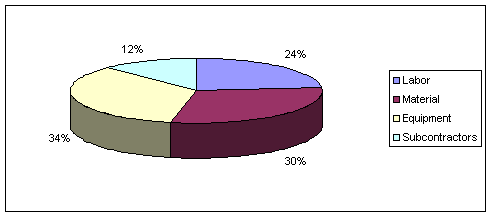
Interestingly enough, all of the percentages for each category are roughly the same in plan and specification projects as they are in tenant finish. This means we can take the same approach when estimating both types of projects. The percentages will vary from project to project but these percentages can be used to double-check the estimates and make sure one category is not grossly different from the average. If a category price is off by a large margin from the average then the sales person should be able to justify why.
Estimating how much the project is going to cost is the first process of any project. If we can better estimate the project up front it will make it easier down the road to have a successful project. Production will also have a more accurate assessment of what they are allowed to spend in each category. Most importantly, by narrowing the estimated variances, Shumate Mechanical can acquire the desired profit margins on future projects.